Cities around the world are rapidly digitalising. Transport systems are becoming smarter, public services are moving online, and artificial intelligence is increasingly embedded in urban life. For persons with disabilities, these shifts can either remove long-standing barriers—or create new forms of exclusion if accessibility is overlooked. Disability-inclusive technology has therefore become a critical issue for smart cities and urban governance worldwide.
This article examines the government role in disability technology, showing how public leadership determines whether digital transformation in cities becomes inclusive or exclusionary. While many disability-related technologies originate in research institutions or the private sector, evidence shows that inclusive outcomes depend on government leadership. Public authorities play a critical role in scaling technology, embedding accessibility standards, and ensuring that digital innovation serves the public interest rather than narrow market demand.
Across regions and income levels, governments are taking different pathways to enable technology for disability inclusion. These approaches vary but they share a common goal: enabling persons with disabilities to participate fully, safely, and independently in urban life.
Government as innovation driver: China

In recent years, China has positioned disability-related technology within its broader science, technology, and industrial development agenda. Public authorities, led by the China Disabled Persons’ Federation, have highlighted the use of advanced technologies such as smart prosthetics, assistive robotics, artificial intelligence, and brain–computer interfaces to support persons with disabilities.
This reflects a state-led innovation model, where government sets strategic direction, mobilises public funding, and coordinates collaboration between universities, research institutes, hospitals, and technology companies. Several applications — such as AI-enabled prosthetic hands and assistive robots in public facilities — are already being piloted or deployed in controlled environments, while more experimental technologies remain at the research or clinical trial stage.
Importantly, disability technology is being integrated into long-term national planning frameworks, including China’s upcoming Five-Year Plan period. This signals a commitment to moving beyond isolated pilots toward systematic development and future scaling.
This approach highlights the importance of government commitment in accelerating innovation for social good. It demonstrates the strength of multi-sector collaborations across the government, academia and private sector and a means to mobilise resources at scale – ensuring that technological progress translates into meaningful inclusion.
Government as standards setter: United Kingdom and European Union
In the United Kingdom and the European Union, governments primarily enable disability-inclusive technology through rights-based standards, regulatory frameworks, and market governance, rather than direct deployment of specific technologies. This approach positions accessibility as a system requirement, shaping how digital services, public infrastructure, and technologies are designed and delivered.
UK’s Disability Inclusion and Rights Strategy 2022–2030 frames assistive technology and digital accessibility as core enablers of inclusion, grounded in the UN Convention on the Rights of Persons with Disabilities. Rather than promoting individual tools, the strategy emphasises mainstreaming accessibility across public policy, procurement, data standards, and programme design, ensuring that public systems do not exclude persons with disabilities by default.
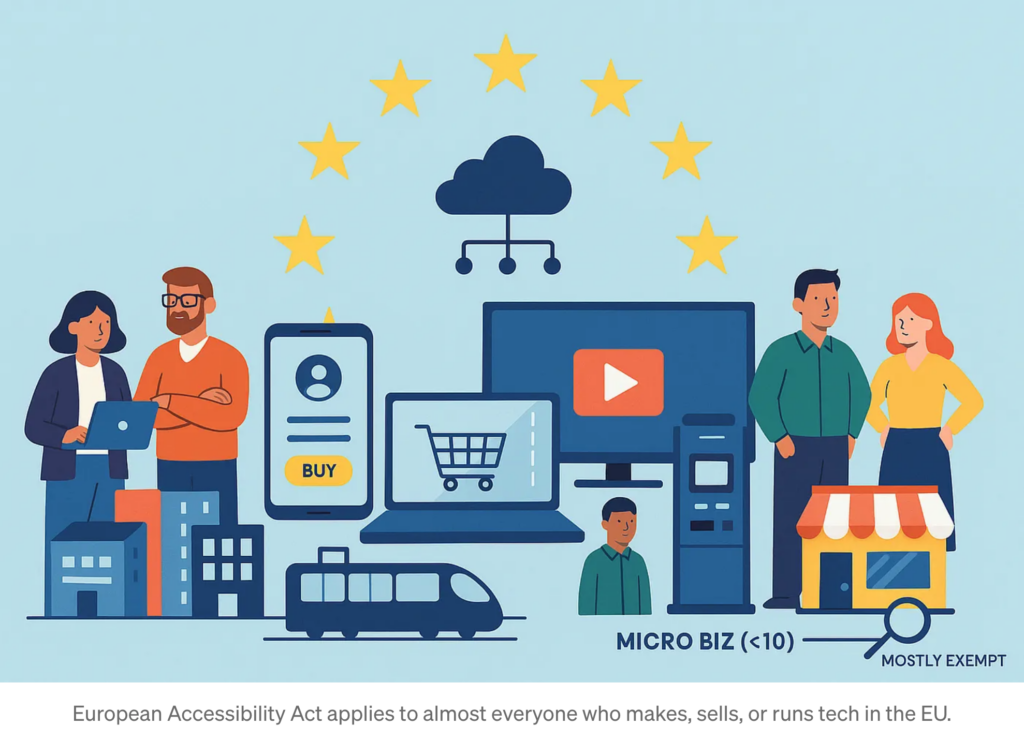
At the EU level, disability inclusion is advanced through a rule-of-law and harmonisation model. Research on EU disability governance highlights the Union’s reliance on binding directives and supranational standards to align national practices. Instruments such as the European Accessibility Act and ICT accessibility standards (EN 301 549) establish common requirements for digital services and technologies across member states, reinforcing the EU’s role as a normative and regulatory authority, even as implementation remains nationally driven.
This approach demonstrates how governments can ensure the inclusiveness of new technologies through equitable policies, ensuring that no one is left behind.
Government as system integrator: Singapore
Singapore adopts a system-integration approach to disability-inclusive technology, where accessibility is embedded across the entire government digital ecosystem rather than delivered through isolated tools or pilot projects. Under its Smart Nation agenda, the government integrates inclusive design into digital governance, service standards, shared platforms, and public-sector capacity-building.
Through the Government Technology Agency of Singapore, accessibility requirements are operationalised via Digital Service Standards that apply across government agencies, ensuring that public digital services are accessible by default. These standards are reinforced through shared infrastructure, including reusable and pre-tested design components, automated accessibility testing tools, and whole-of-government analytics that allow agencies to monitor and improve accessibility performance over time.
In parallel, Singapore invests in systematic training and knowledge-sharing for public officers and incorporates feedback from persons with disabilities into service design. This integrated model demonstrates how governments can translate accessibility principles into consistent, everyday digital experiences, making inclusion a routine feature of urban life rather than a specialised intervention.

From innovation to inclusion: what cities can learn
The experiences of China, the United Kingdom, the European Union, and Singapore show that there is no single model for enabling disability-inclusive technology. While governments may adopt different strategies — whether as innovation drivers, standards setters, or system integrators — inclusive outcomes are strongest when technology is embedded into public systems rather than treated as a standalone solution.
Across these different pathways, several common lessons emerge. First, accessibility must be built in from the outset, not retrofitted after technologies are deployed. Second, public leadership matters — whether through funding, regulation, procurement, or system integration. Third, participation of persons with disabilities is essential to ensure that technologies respond to real needs rather than assumed ones.
As cities continue to digitalise, the question is no longer whether technology will shape urban life, but how governments choose to govern it. When accessibility, accountability, and inclusion guide technological development, digital innovation becomes a powerful enabler of healthier, more equitable cities for all.