


Bangkok urban water infrastructure is evolving beyond concrete drainage systems. At Benjakitti Park, a former tobacco factory has been transformed into one of the city’s most significant nature-based water management landscapes.
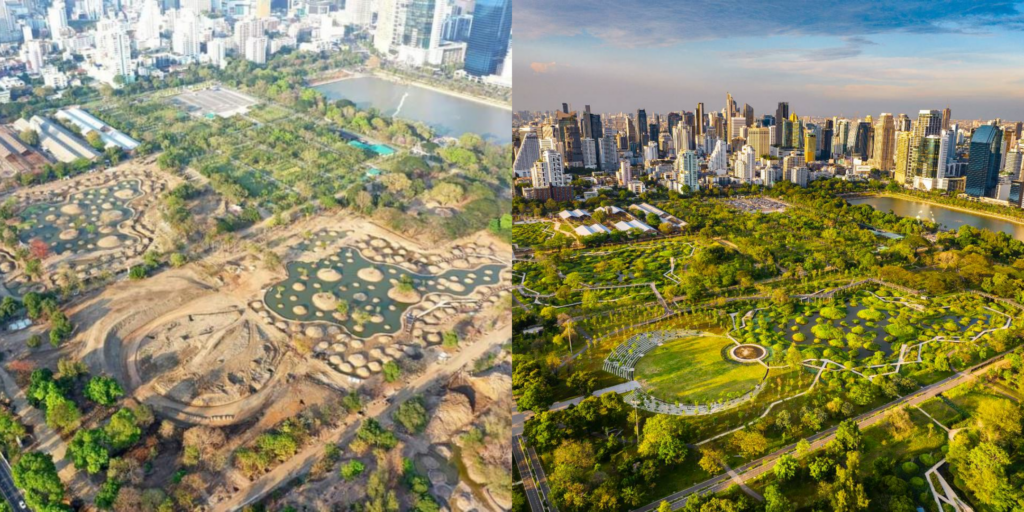
Designed under the concept of “Water + Forest,” the 259-rai forest zone (within the larger 450-rai Benjakitti development) was never intended to be just another city park. It was conceived as an urban reservoir embedded within Bangkok’s low-lying delta geography—a landscape designed to intentionally interact with water rather than resist it.
In a city where flooding is seasonal reality, Benjakitti Park demonstrates how green space can function as critical infrastructure.
Designing with Water, Not Against It
Bangkok sits on a floodplain with high groundwater levels—dig just one metre and water appears. Instead of extracting or storing groundwater, the design team worked with the site’s hydrology.
The strategy was simple but radical: increase surface retention capacity. Rather than building concrete embankments or underground tanks, the land was reshaped into a “sponge landscape” that slows runoff, absorbs rainfall, and temporarily stores stormwater.
Flooding here is not a failure. It is a programmed performance.
Urban Reservoir in the Heart of Bangkok
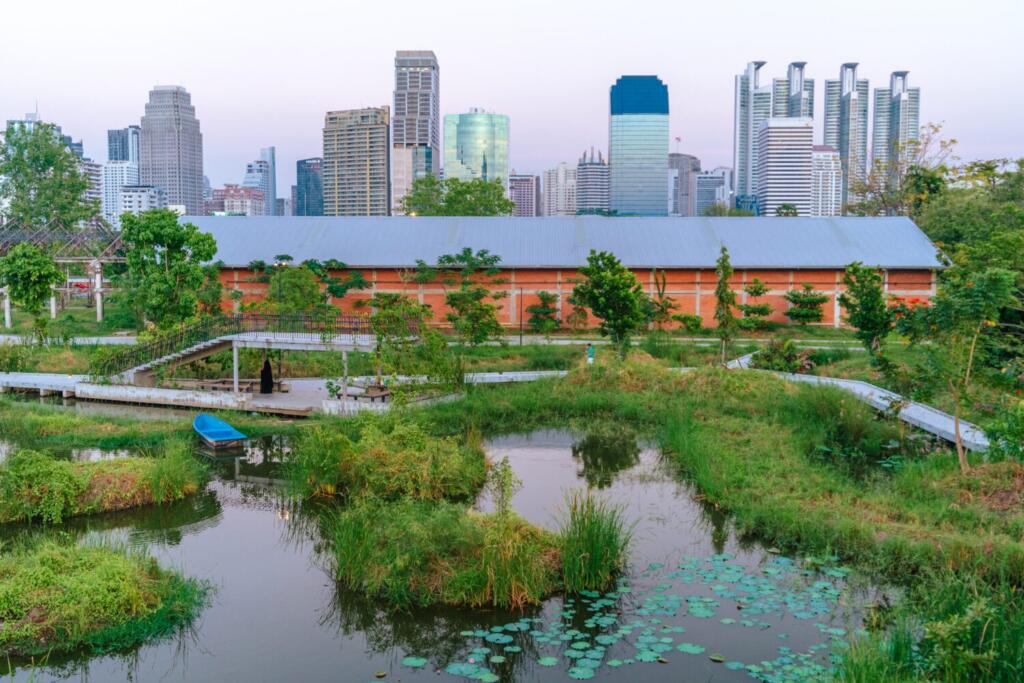
Benjakitti Park functions as a large-scale urban retention basin. Using cut-and-fill earthworks inspired by traditional Thai ridge-and-ditch agricultural systems (ร่องสวน), the former industrial ground was sculpted into:
- Interconnected basins
- Shallow wetlands
- Elevated mounds
- Deep and shallow ponds
At full capacity, the park can store 128,000 cubic metres of water. Water levels can be lowered in advance of major storms, creating additional storage space when needed. In severe flood conditions, surrounding overflow can be intentionally diverted into the park.
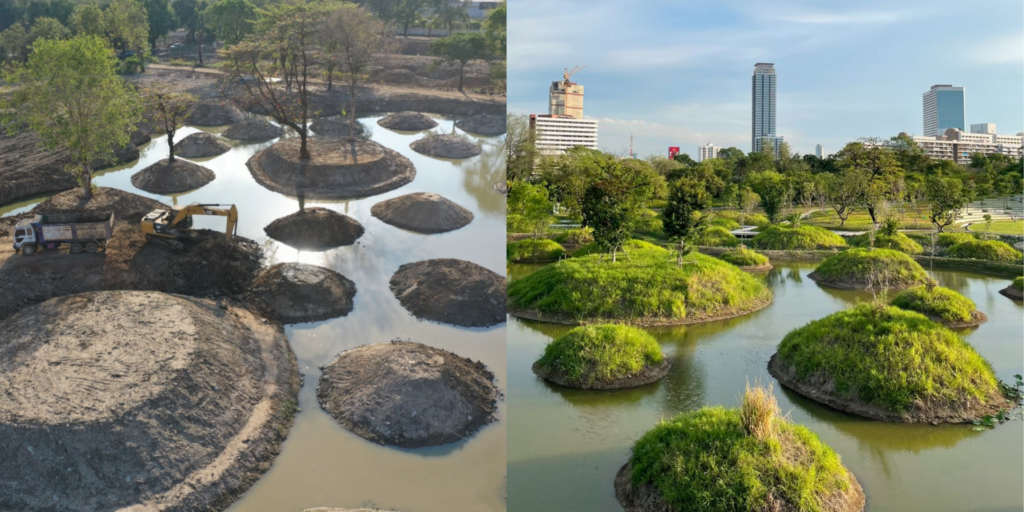
According to the design team, the system can help buffer runoff from two major storm events. Approximately 95% of the park’s surface functions as a permeable or retention landscape during heavy rainfall.
The soil itself—rather than concrete embankments—acts as the primary storage medium, absorbing and gradually releasing water.
This transforms the park into a functioning piece of blue-green infrastructure.
Designed to Flood — But Still Usable
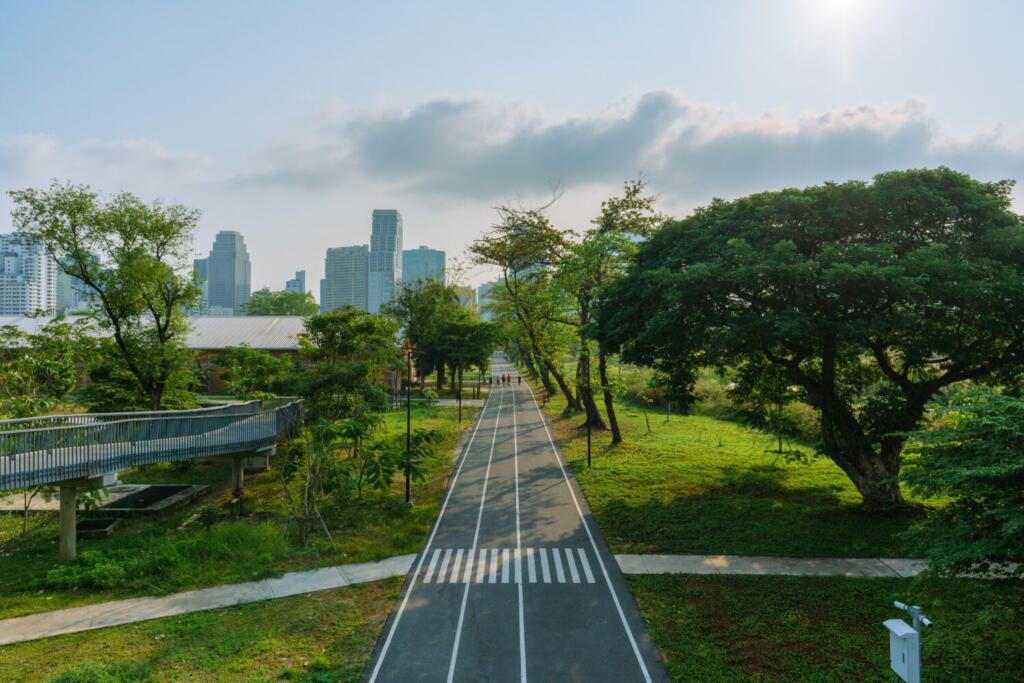
Unlike traditional parks that close during flooding, Benjakitti Park was engineered to remain accessible.
When water levels rise:
- Ground-level areas may temporarily retain water
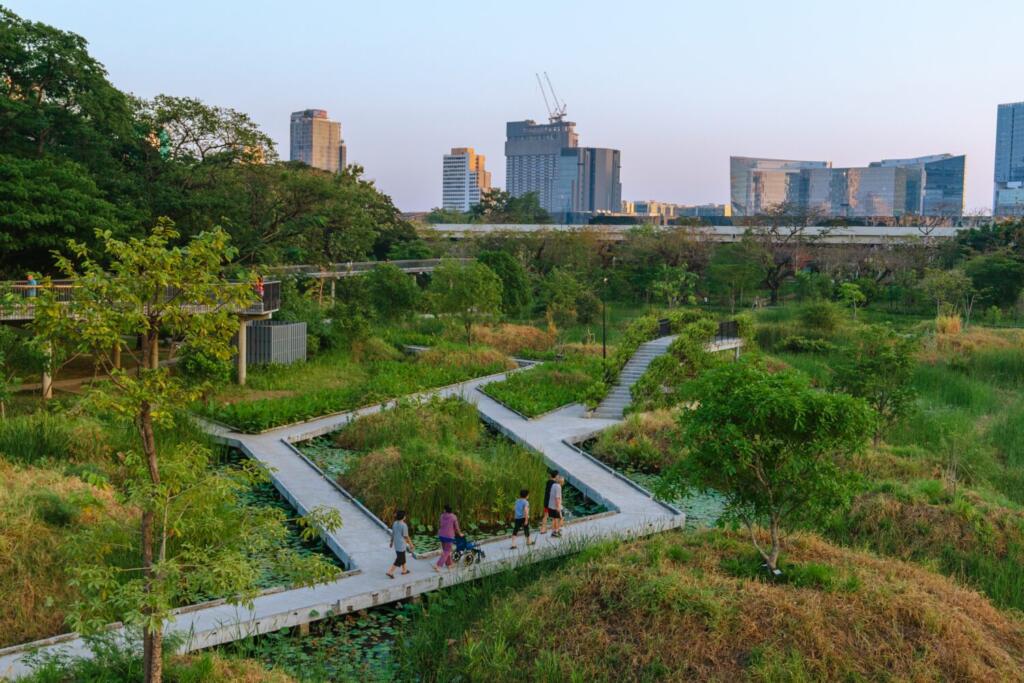
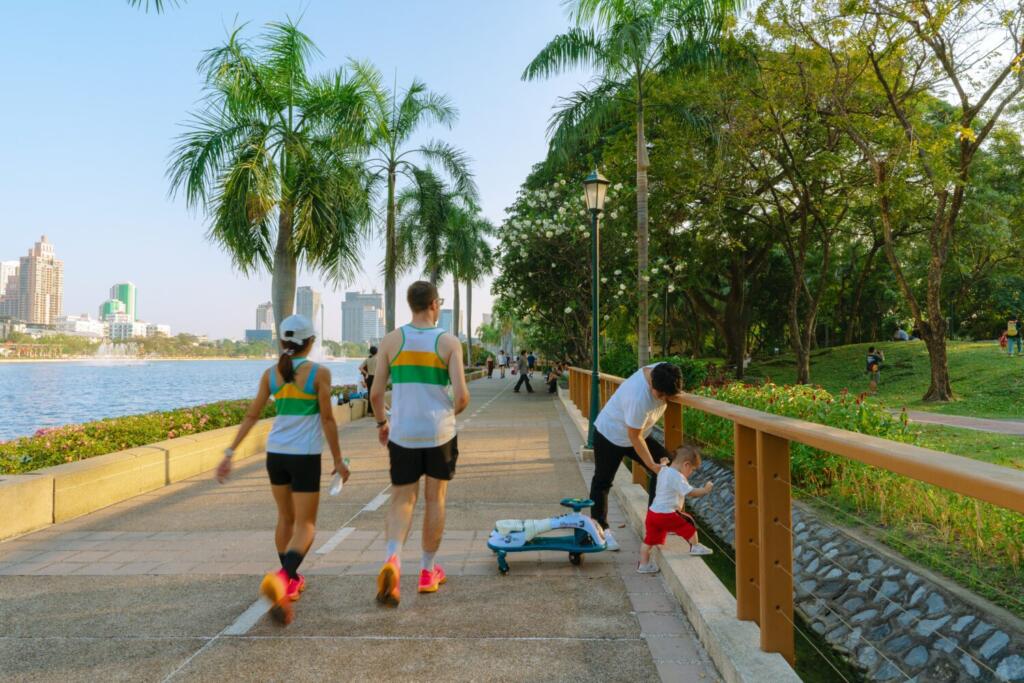
- Boardwalks guide circulation above wetlands
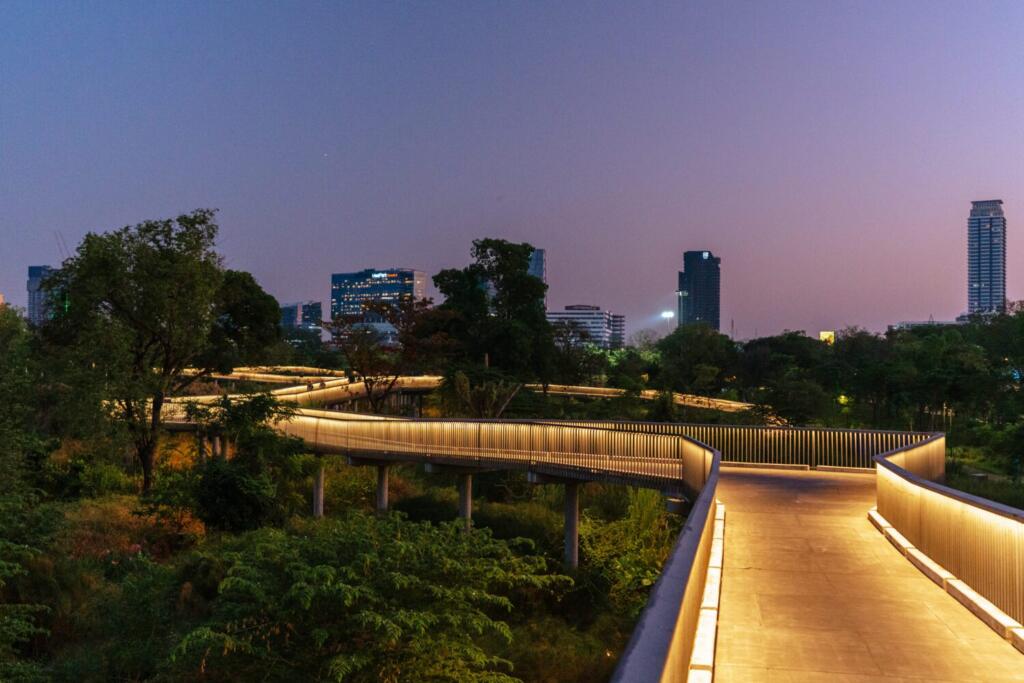
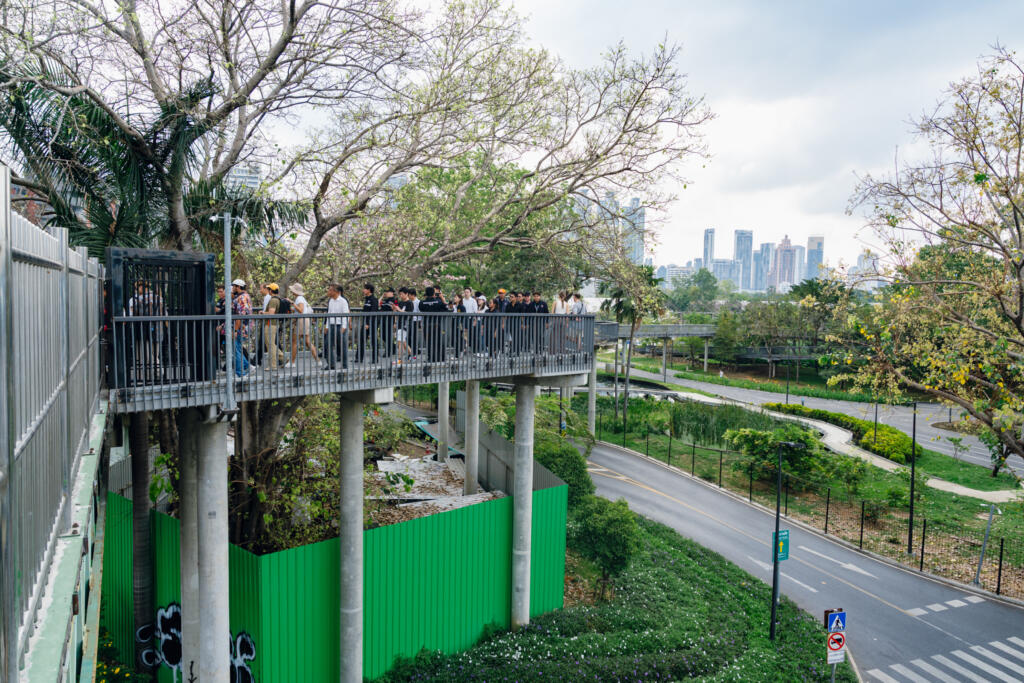
- Elevated skywalks remain fully operational
Even during heavy storms, the skywalk maintains connectivity between districts and links toward Lumpini Park via the Green Bridge. This multi-level circulation system—ground paths, boardwalks, and skywalk—ensures that public life continues even during flood events.
Benjakitti Park is not flood-proof. It is flood-adapted.
How Water Is Treated
Flood control is only one layer of the system. Water from the adjacent Khlong Phai Singto canal is treated through a constructed wetland system using:
- Aeration (waterfall drops and gravity flow)
- Sunlight exposure
- Controlled slope gradients (as little as 1%)
- Retention time
- Aquatic vegetation acting as active biological filters
Before treatment, canal water can reach BOD levels of approximately 70 mg/L. After ecological filtration, BOD levels drop to below 10 mg/L, making it suitable for reuse within the park.
The park relies exclusively on rainwater and treated canal water. No metropolitan water supply is used for irrigation. This closed-loop system reduces dependency on external infrastructure while improving local water quality.
Vegetation Designed for Flood Resilience
The ecological strategy supports hydrological performance.
- Over 5,600 newly planted trees, primarily native saplings
- More than 400 plant species
- Vegetation capable of surviving 2–4 days of inundation
- More than 100 recorded bird species
Unlike decorative urban landscaping, the planting strategy prioritizes:
- Adaptation
- Self-sufficiency
- Reduced long-term maintenance
- Habitat restoration
Earthworks were fully balanced on-site—no soil was imported or exported—revitalizing compacted former industrial ground without chemical dependency.
From Industrial Site to Living Water Infrastructure
What makes Benjakitti Park remarkable is not just its scale. It integrates:
- Flood retention
- Ecological water treatment
- Urban heat mitigation
- Biodiversity habitat
- Recreational infrastructure
- Climate resilience
The project challenges a common misconception: Green space is not ornamental in flood-prone cities. It is infrastructure.
Benjakitti Park demonstrates how delta megacities facing climate change can utilise landscape architecture as an adaptive water management system—not just a public amenity.
Source: Bangkok Metropolitan Administration


1 Comment
Comments are closed.