Inclusive and universal design are essential approaches for creating healthy cities that celebrate human diversity, ability, age, and lived experience.
Our societies are composed of diverse persons, each unique with distinct identities and perspectives. As we design our cities, it is therefore essential to ask: Who are we designing for? Urban design must begin with the recognition that people differ in physical and cognitive abilities, languages, cultures, gender, age, and other dimensions of human diversity.
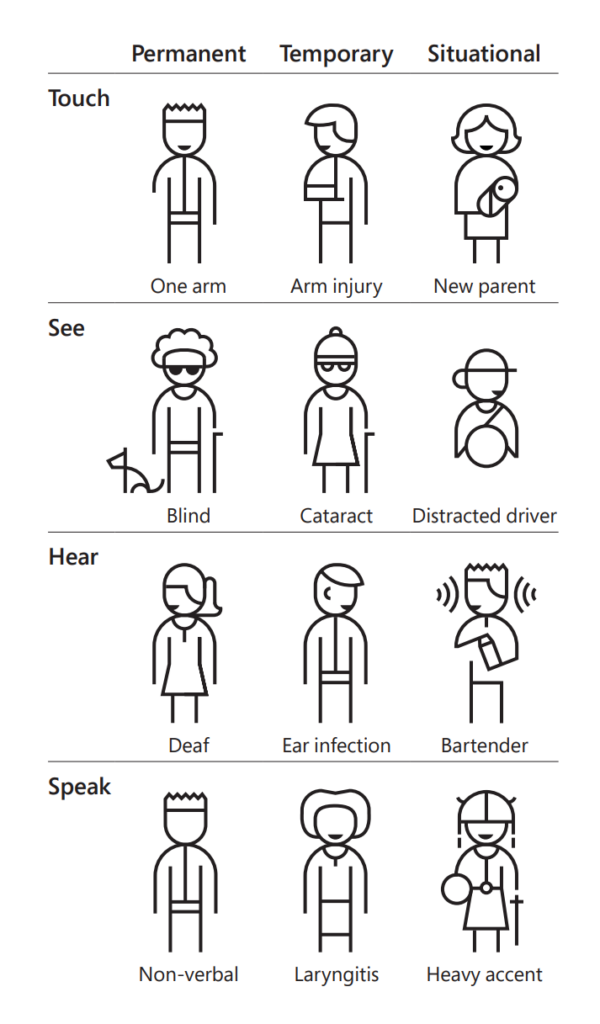
The Persona Spectrum, introduced in Microsoft Inclusive Design Guidebook, helps illustrate how people experience environments differently across the senses of Touch, Seeing, Hearing and Speaking, as well as across temporary, situational, and permanent conditions.
Experience is gendered. Men and women use public spaces at different times of the day, face varied challenges and needs. Children, youths, adults and elders seek different forms of recreation and require different accommodations. Socio-cultural factors further shape lived experience in cities.
Inclusive Design as a Participatory Approach
Inclusive Design is an approach to consider the full range of human diversity – incorporated into the accessibility and usability of designs.
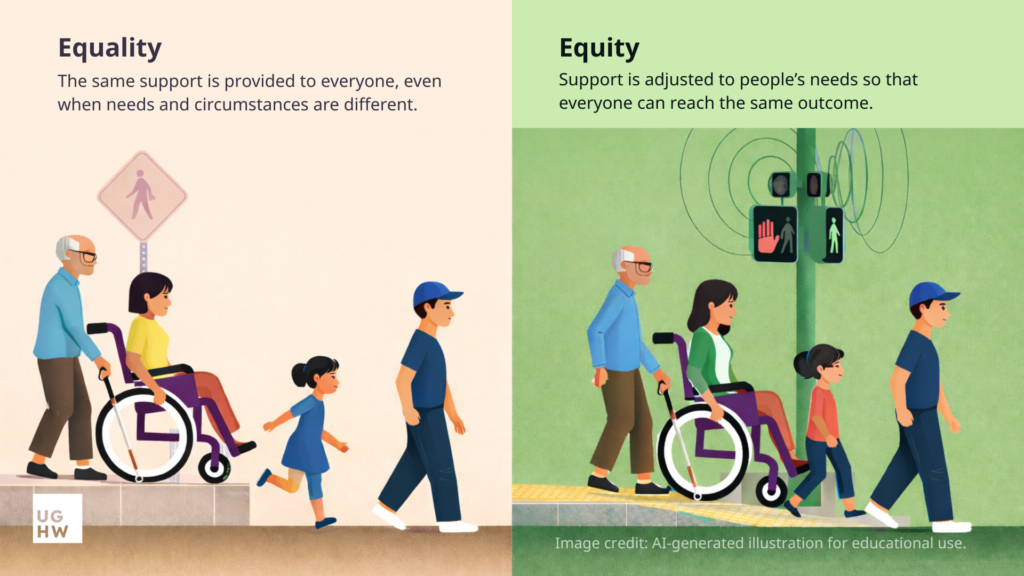
It is, at its core, a participatory approach. In the book Mismatch: How Inclusion Shapes Design, Kat Holmes describes how inclusive design works with rather than for excluded users – resulting in solutions that work well and benefit all. This process is one that advances equity by creating levers and support for different needs to enable everyone to ultimately arrive at the same outcome.
Principles for Inclusive Design include:
- Recognizing Exclusion – questioning existing biases and defaults
- Learning from Diversity – placing people at the center from the start of the process
- Solve for One, Extend to Many – designing for people with both permanent and temporary disability in ways that benefit people universally
Universal Design
The principle ‘Solve for One, Extend to Many’ arrives as Universal Design, where the design is usable by all people to the greatest extent possible, without the need for further adaptation or specialized solutions.
Universal design represents the outcome of inclusive design, where consideration of diverse needs results in spaces that are inherently accessible.
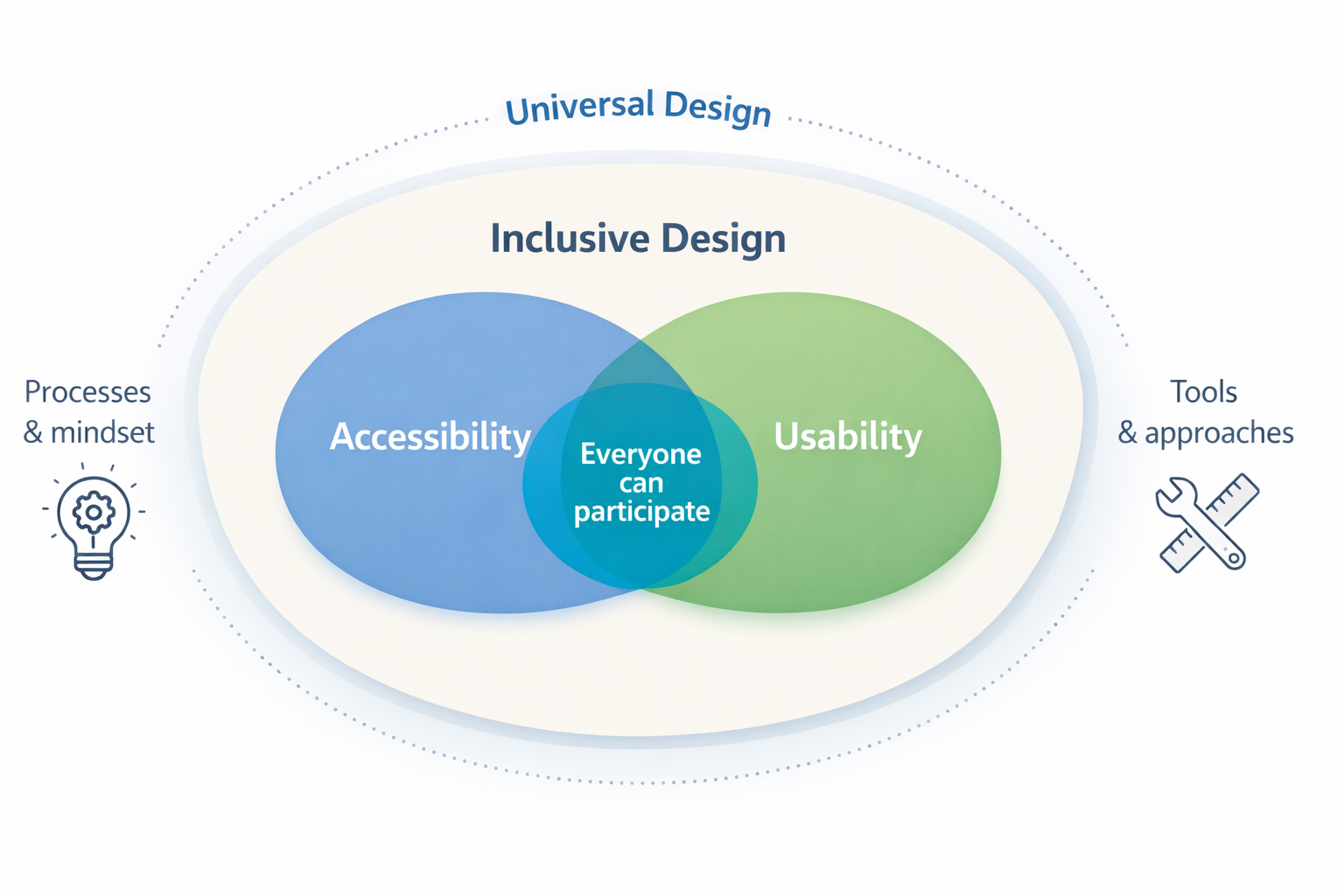
Source: Ris Wong
Universal design of spaces empowers people of different backgrounds and abilities both in built environments and in the community. By enabling access, diverse persons can participate more fully in daily activities, including recreation and work. This improves both physical and mental well-being of the population.
Inclusive design is closely interlinked with the sense of belonging we share. When environments are inclusive, we feel seen, heard, and enabled. By adopting inclusive and universal design in the planning and design of healthy cities, we can grow healthier, together.
Foo Jia Xin, General Manager
Sources
Wong, Ris. (2023). Inclusive Design, Accesibility, and Universal Design. https://www.youtube.com/watch?v=x6G3zJOCQM4
Microsoft. (n.d). Microsoft Inclusive Design. https://inclusive.microsoft.design/
Robert Wood Johnson Foundation. (2017). Visualizing Health Equity: One Size Does Not Fit All Infographic. https://www.rwjf.org/en/insights/our-research/infographics/visualizing-health-equity.html